The question is not whether to govern AI. It is which architecture governs it best.
GCC enterprises are running generative AI in production. Thirty-nine percent of MENA enterprises have already crossed that threshold. Most cannot demonstrate that the AI they are running is governed, measurable, or compliant with the PDPL, QCB, and Dubai AI Seal frameworks that are moving from aspiration to audit across the region.
The governance gap is structural. It is not the result of inattention. It is the result of a sequence problem: deployment arrived before the governance architecture did. Platforms were acquired. Agents were deployed. The question of who owns them, what they are authorised to do, and how a regulator or board would audit that ownership was deferred to a later phase that has not arrived.
ServiceNow AI Control Tower is the most comprehensive commercial answer to that gap available in 2026. But it is not the right answer for every estate. The build versus buy question depends on three variables: what the organisation already has, how urgent the governance gap is, and whether the foundations exist for a governance platform to be effective. Getting the answer wrong in either direction, adopting AI Control Tower where a different architecture is more appropriate, or deferring governance where urgency demands action, carries real cost.
"Governance applied after deployment is not governance. It is documentation of a risk that already materialised."
Avero White Paper · May 2026
The full governance architecture analysis.
13 pages. Free download.
Regulation · GCC Mandates
The regulatory clock is not aspirational. It is already running.
PDPL enforcement is live and expanding in scope. QCB guidance on AI in financial services is moving from advisory to audit. The Dubai AI Seal is transitioning from an aspirational quality standard to a verifiable compliance requirement. The EU AI Act applies to any GCC organisation with European operations, customers, or data subjects. Four live mandates, simultaneously, in 2026.
The practical implication for the build versus buy decision is direct. An organisation with an imminent PDPL audit or QCB review cannot afford the twelve to eighteen months that building a governance layer from open-source components typically requires. For organisations facing imminent regulatory exposure, the decision is effectively already made. For those with more time, the architecture still needs to be designed to produce the evidence those mandates will eventually require: named AI asset ownership, completed risk assessments, audit trails, and documented human oversight paths.
Governance · What Good Looks Like
What defensible AI looks like in practice.
The organisations that have successfully governed AI deployment at scale share a common pattern: they treated governance as a day-one architectural constraint, not a retrospective compliance exercise. Before the first agent goes into production, ownership is documented, risk is assessed, an audit trail is established, and the human escalation path is defined for decisions that fall outside the agent's operating parameters. These are not post-deployment additions but the preconditions that determine whether the AI programme is defensible when the regulator or the Board makes the request.
The barrier is not technical complexity but the assumption that governance is something added later, once the use case is proven. That assumption is the most expensive mistake in AI programme management, because every agent deployed without governance infrastructure is a liability that compounds with every decision it makes, and the compounding is invisible until it materialises at exactly the wrong moment.
Seventy-eight percent of business executives lack confidence their organisation could pass an independent AI governance audit within 90 days, and AI deployment metrics are nine times less likely to have a named owner than standard business KPIs. These are not organisations that chose to defer governance but organisations that did not know governance needed to be present from the outset.
Governance · ServiceNow K26
What AI Control Tower actually is in 2026.
AI Control Tower was introduced at Knowledge 2025 as a visibility layer, a dashboard showing what AI assets existed and how they were performing. At Knowledge 2026 it became an active governance infrastructure. It does not merely observe agents. It governs them in real time, constrains them within defined permissions, and can terminate them when they operate outside their intended scope. This distinction matters because most competing governance tools operate at the observation layer. AI Control Tower operates at the execution layer, where agents take actions, trigger approvals, and affect business outcomes.
Five functional pillars define what it does. Discovery maps every AI asset across thirty-plus enterprise integrations, AWS, Azure, GCP, SAP, Oracle, Workday, and Microsoft Agent 365 among them, regardless of where those agents were built. Observe provides live runtime monitoring of agent behaviour, not just deployment configuration. Govern activates NIST AI RMF, EU AI Act, PDPL, QCB, and Dubai AI Seal compliance frameworks without requiring them to be built from scratch. Secure extends identity access governance to every non-human identity across the estate via the Veza integration, mapping thirty billion permissions across every human and non-human identity with a real-time kill switch when an agent operates beyond its defined scope. Measure provides cost tracking and ROI dashboards, giving organisations the financial evidence that ninety-five percent of enterprises globally cannot currently produce when a board or regulator requests it.
The commercial model at K26 is significant. AI Control Tower is now included by default in every ServiceNow product and package, no longer a separate SKU, and is available free for the first year at a stated value of two million dollars. That is a land-and-expand strategy, not a permanent pricing position. Year two economics must be modelled before the free year begins. Organisations that understand this and commit with open eyes are in a better position than those who discover it at renewal.
"The free year removes the financial barrier. It does not remove the platform commitment."
Architecture · McKinsey QuantumBlack
The composable and compostable principle, and why it matters here.
McKinsey QuantumBlack's April 2026 research on enterprise agentic platform architecture provides the most rigorous vendor-agnostic framework available in the market. It is the essential counterweight to any single-platform governance narrative. The research is grounded in three live financial institution deployments, a European bank automating credit workflows, a large financial services organisation building a digital factory of agents, and a global bank reinventing its software development lifecycle, all directly relevant to the GCC enterprise context.
The central architectural recommendation is that enterprise agentic platforms should be composable, built from modular components that can be assembled into complex systems, and compostable, designed so individual components can be replaced without requiring a full architectural redesign. This principle is the primary safeguard against the platform lock-in risk inherent in any governance architecture choice. McKinsey recommends a buy-partner-build framework applied component by component: buy where clear market solutions exist, partner where viable solutions are emerging, build selectively only where genuine differentiation is possible and the effort is justified.
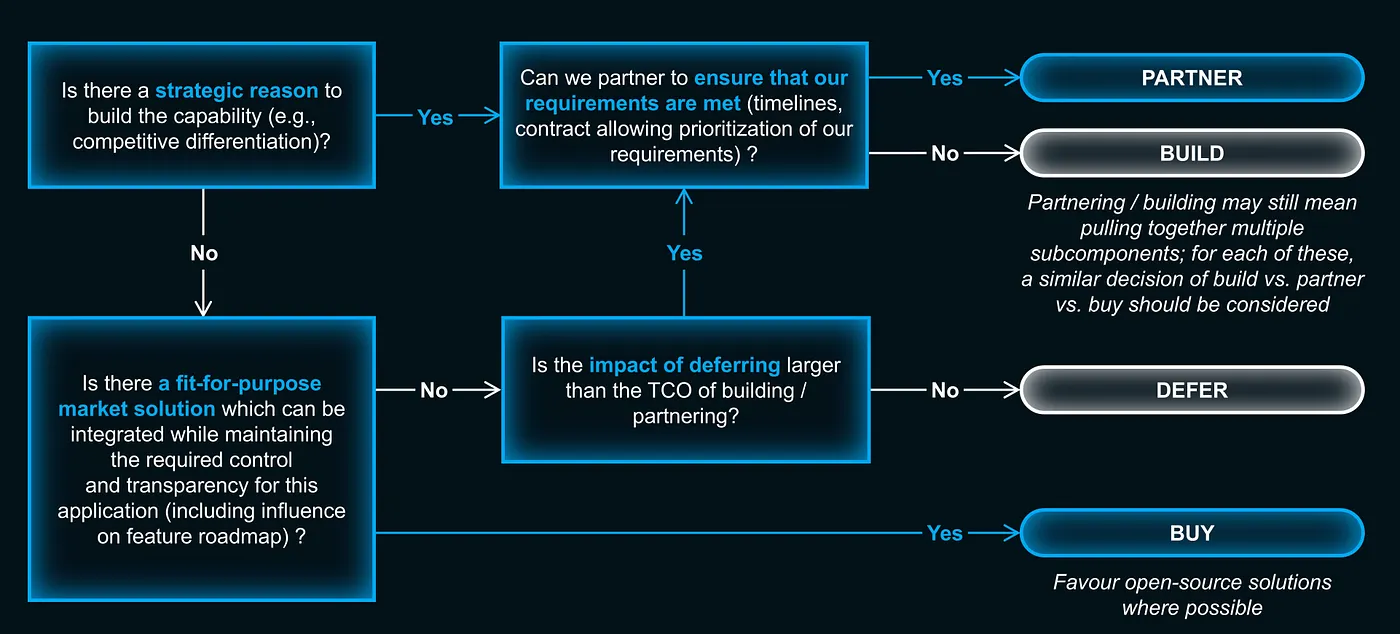
McKinsey QuantumBlack's build versus buy decision framework: strategic reason to build, fit-for-purpose market solution, and impact of deferral are the three primary routing questions. Source: QuantumBlack, AI by McKinsey, April 2026.
Three design principles sit beneath this framework. First, protocol-first interoperability: for any agentic system that interacts with external agents and tools, open protocols are the primary mechanism for preserving multi-vendor flexibility. Agent2Agent (A2A) enables direct communication between agents across platforms. Model Context Protocol (MCP) enables governed access by agents to external tools and data at runtime. ServiceNow's AI Gateway at K26 is built on MCP, a signal that even a platform-centric architecture can embrace open standards at the integration layer. Second, production readiness from day one: four foundational capabilities must be in place from the first agent in production, agentic evaluation, agent discoverability, memory management, and feedback loops. Organisations that treat these as later-phase work consistently fail to scale. Third, constant exploration: the market is nascent and any architecture must be designed to evolve without requiring a full redesign.
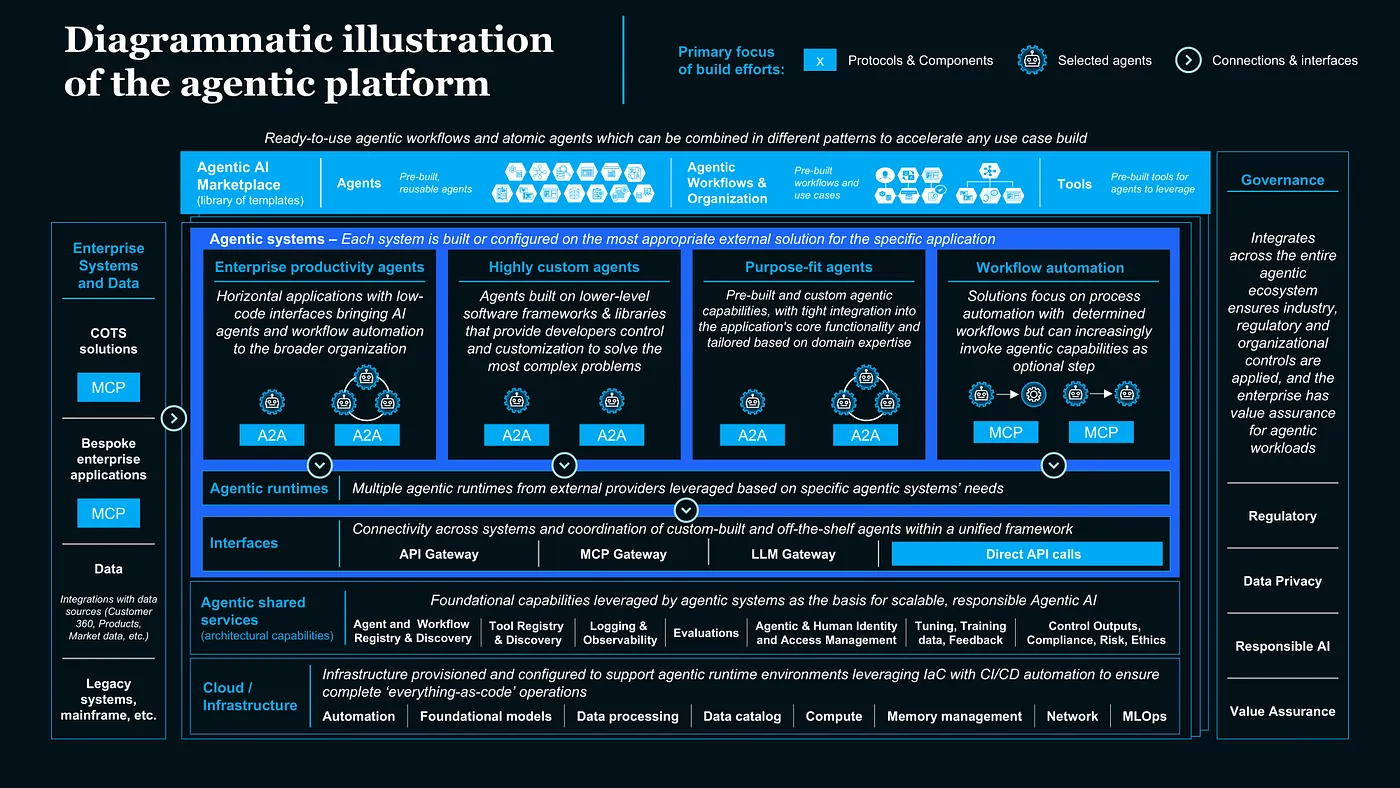
McKinsey QuantumBlack's enterprise agentic platform architecture: marketplace, agentic systems, runtimes, interfaces, shared services, and infrastructure, with governance running vertically across the entire stack. Source: QuantumBlack, AI by McKinsey, April 2026.
The shared services layer in McKinsey's architecture is the most direct point of comparison with AI Control Tower. Agent and workflow registry and discovery, logging and observability, evaluations, agentic and human identity and access management, tuning and feedback, and control outputs for compliance and ethics, these are the six capabilities McKinsey identifies as foundational to any scalable, responsible agentic platform. AI Control Tower addresses all six. The question is whether it addresses them in a way that is composable and compostable enough to remain viable as the market matures. That is the honest architectural tension at the centre of the build versus buy decision.
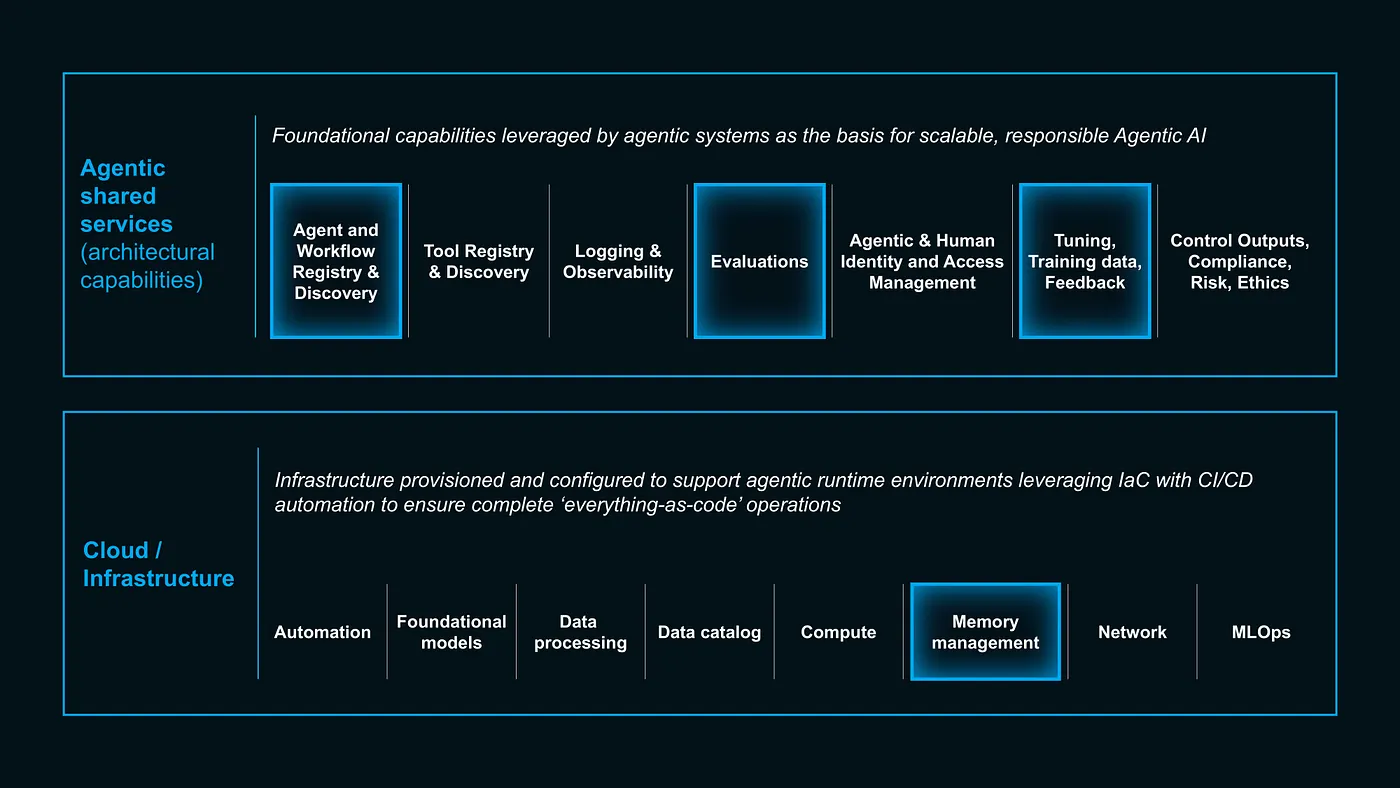
The agentic shared services and infrastructure layers in detail: agent and workflow registry, tool registry, logging and observability, evaluations, identity and access management, tuning and feedback, and compliance controls, the six capabilities that must exist for any governance layer to be effective. Source: QuantumBlack, AI by McKinsey, April 2026.
Market · Competitive Architecture
Who else governs what agents do, and where each falls short.
No single vendor replicates AI Control Tower's full capability set. Several cover significant portions. The right architecture depends on the estate, and honest advice requires saying so rather than defaulting to the most available answer.
Microsoft's governance stack, Purview for data lineage and compliance, Entra ID for identity, Azure AI Foundry for agent runtimes, is already embedded in most GCC enterprises via M365. Purview's strength is data-layer governance: classification, lineage, compliance policy. Its gap is workflow execution governance. Microsoft does not natively understand the approval chains, escalation logic, and business rules that determine whether an agent action is appropriate. ServiceNow's K26 announcement extending AI Control Tower into Microsoft Agent 365 is a direct move to fill this gap, governing Microsoft's own agents at the execution layer Microsoft cannot reach natively. For Microsoft-heavy estates, both platforms have a role. The design challenge is where the boundary sits.
Boomi and MuleSoft are prerequisites, not competitors. Clean master data, maintained through Boomi DataHub or MuleSoft, is the foundation on which any AI governance layer must stand. Governance on inconsistent data produces inconsistent governance. For integration-platform-led estates, the conversation must begin with the data foundation, not the governance platform. AWS Bedrock AgentCore and Google Vertex AI provide strong infrastructure-layer governance, guardrails, session management, audit logging, but do not understand business-process context. They govern the model. They do not govern the approval workflow, the compliance obligation, or the escalation path.
The open-source path, LangGraph, Phoenix by Arize AI, LangSmith, McKinsey's own open-sourced ARK platform, is the most architecturally defensible position on vendor lock-in and the one McKinsey's research explicitly validates. It requires a dedicated platform engineering team capable of building, integrating, and continuously maintaining a bespoke governance stack. Most GCC enterprises do not have this capacity internally. Where they do, it is the right answer.
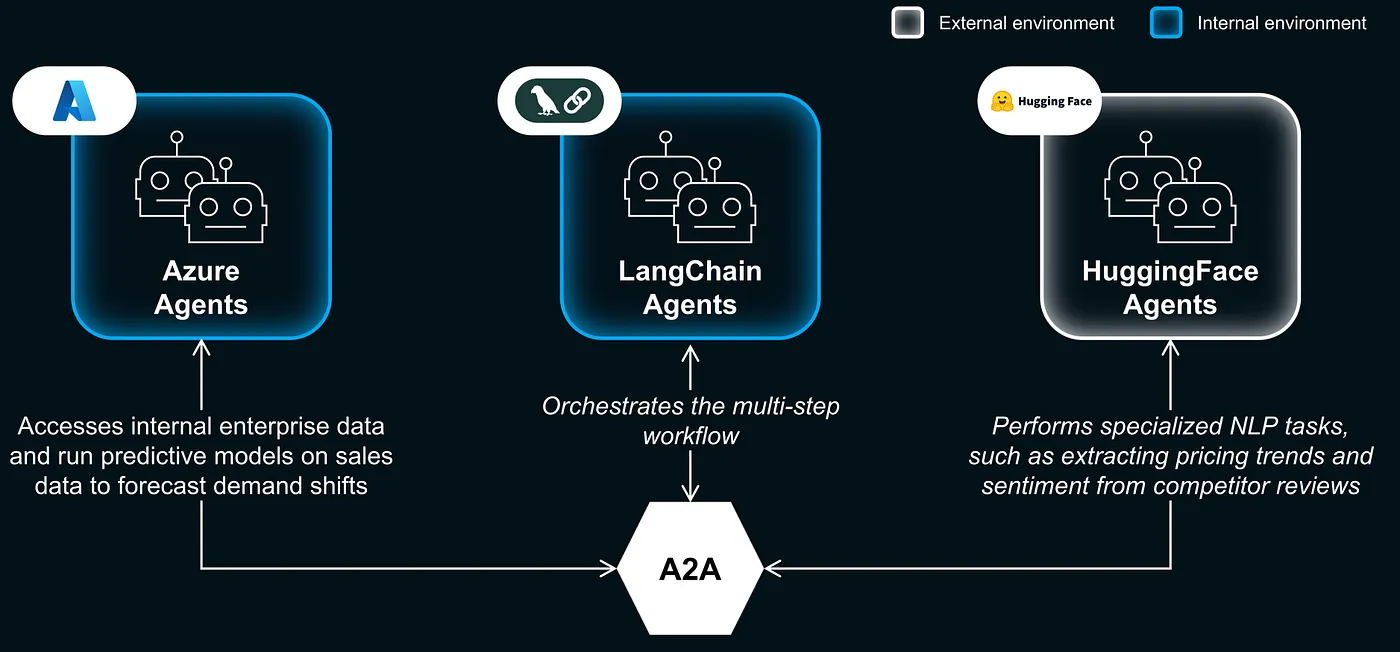
The A2A protocol in practice: Azure Agents accessing internal enterprise data, LangChain Agents orchestrating multi-step workflows, and HuggingFace Agents performing specialised NLP tasks, all communicating via the open Agent2Agent protocol. This is the protocol-first interoperability principle McKinsey identifies as the primary safeguard against lock-in. Source: QuantumBlack, AI by McKinsey, April 2026.
| Capability | ServiceNow AICT | Microsoft Purview | Boomi / MuleSoft | Hyperscaler | Open Source |
|---|---|---|---|---|---|
| Execution-layer governance | Native, 22yr workflow data | Data/policy only | Emerging | Infra layer only | Build required |
| GCC regulatory frameworks | PDPL, QCB, Dubai AI Seal | EU/US focus | Data only | Infrastructure only | Build required |
| Cross-vendor agent discovery | 30+ integrations | Microsoft-centric | Integration layer | Platform-centric | Build required |
| NHI identity governance | Veza, 30B permissions | Entra ID only | Not primary | IAM roles only | Build required |
| Real-time kill switch | Yes, K26 proven | Policy-based | No | Guardrails only | Custom build |
| Multicloud neutrality | Integrates, SN-centric | Microsoft-centric | Genuinely agnostic | Platform-centric | Fully portable |
| Vendor lock-in risk | High | High | Medium | Medium | Lowest |
| Year 1 cost | Free (stated $2M value) | Bundled / complex | Subscription | Consumption | High build cost |