The platform arrived. The question is whether the foundation did.
Every major conference has a signal beneath the announcements. At Knowledge 2026, the signal was this: ServiceNow has completed the architecture for autonomous enterprise operations. AI Control Tower now governs agents across more than thirty enterprise systems, not just ServiceNow-native deployments. Action Fabric opens the entire ServiceNow workflow estate to any third-party agent as governed execution. Otto replaces the concept of employee self-service with a single intelligent front door spanning IT, HR, Finance, Legal and Procurement. The Autonomous AI Specialist roles, covering every major GBS function, are generally available today.
None of those announcements resolved the structural questions that determine whether they land as genuine capability or as accelerated liability. A more powerful platform deployed on a weak foundation does not strengthen the foundation. It exposes it faster, at greater scale, with fewer opportunities to correct quietly.
"A more powerful platform deployed on a weak foundation does not strengthen the foundation. It exposes it faster."
Governance · AI Control Tower
Governance expanded. The foundation it requires did not come with it.
AI Control Tower was first introduced as a visibility layer. At K26 it became an active governance platform — discovering, observing, governing, securing, and measuring AI assets across AWS, Azure, SAP, Oracle, Workday, Microsoft Agent 365, and more than thirty other enterprise systems. The live keynote demonstration showed a malicious instruction propagating across nearly two thousand agent requests in a two-hour window, detected in real time, traced to its source, and deactivated with a single control. The product is serious and the capability is real.
What AI Control Tower governs is what has been registered, inventoried, and brought into scope. It does not repair the CMDB that drifted from reality eighteen months after go-live. It does not resolve a service classification that was never maintained. It does not create the ownership model that decides who is accountable when an agent makes a wrong decision at scale. The Control Tower governs the agents. The governance of the foundation beneath them is a different workstream entirely, and it has to exist before the agents are deployed, not assembled in response to what the Tower reveals.
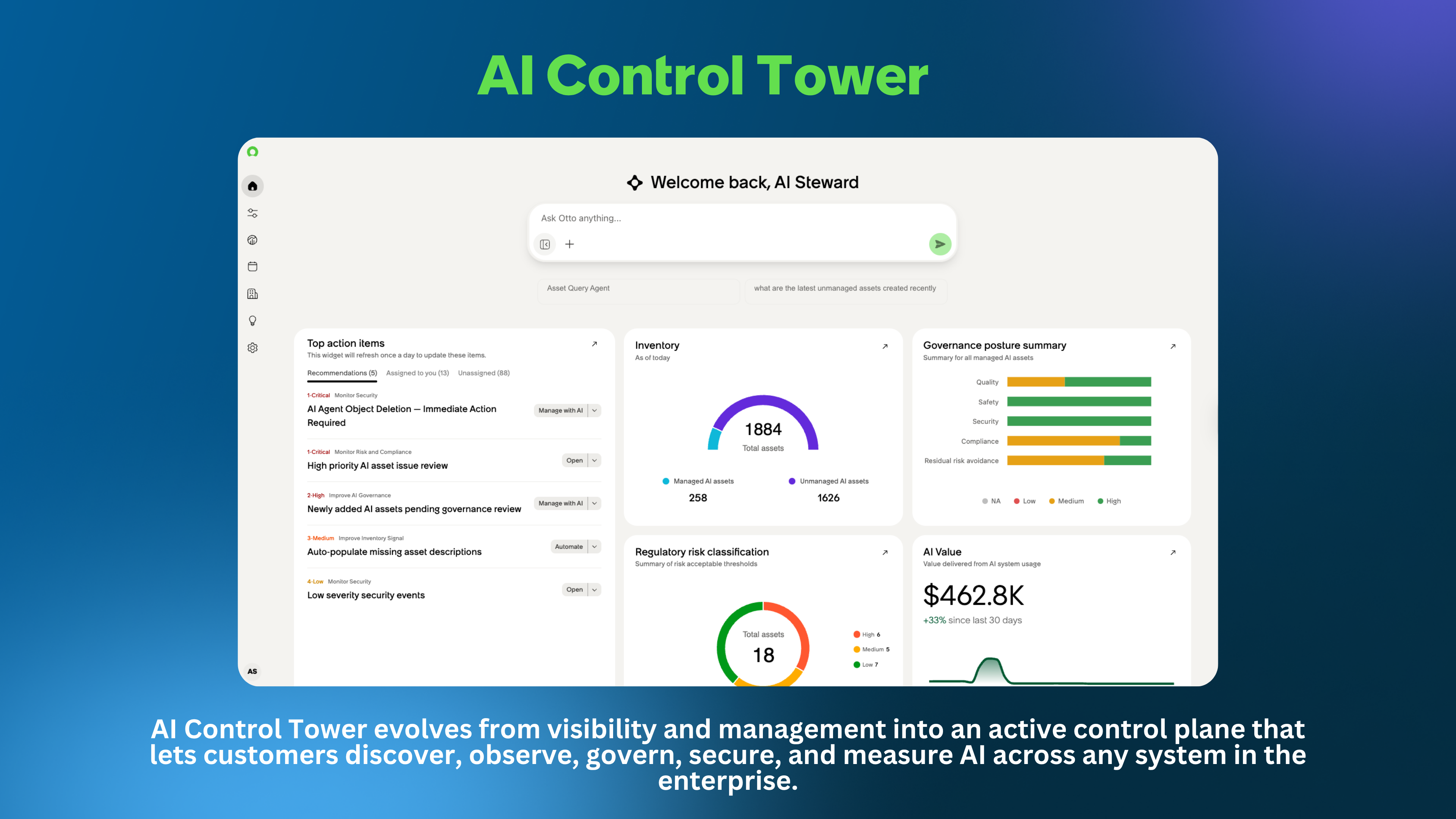
The AI Control Tower dashboard at K26: 1,884 total AI assets tracked across managed and unmanaged inventory, real-time governance posture across Quality, Safety, Security, Compliance and Residual Risk. The gap between 258 managed and 1,626 unmanaged assets in this screenshot is the governance problem most organisations are not yet measuring.
Execution · Action Fabric
Governed execution requires governance that pre-exists the agent.
Action Fabric is the architectural shift that makes K26 materially different from every ServiceNow conference before it. Any third-party agent — whether built on Claude, Copilot, or a proprietary model — can now trigger ServiceNow workflows, approval chains, and business rules directly, without a user interface, with every action identity-verified, permission-scoped, and fully auditable. ServiceNow is no longer a system of record that agents query. It is the system of action through which agents execute governed enterprise work.
The word governed in that description is load-bearing. Action Fabric executes whatever governance model already exists in the platform. An agent that triggers a Hire-to-Retire workflow in an environment with clear process ownership, a maintained data model, and defined accountability at every stage will execute governed work. An agent that triggers the same workflow in an environment where the onboarding process was configured three years ago and never updated, where the responsible team no longer exists in its original form, and where no one has formally reviewed the business rules since go-live, will execute those conditions at speed and scale without pausing to ask whether they still reflect how the business actually operates.
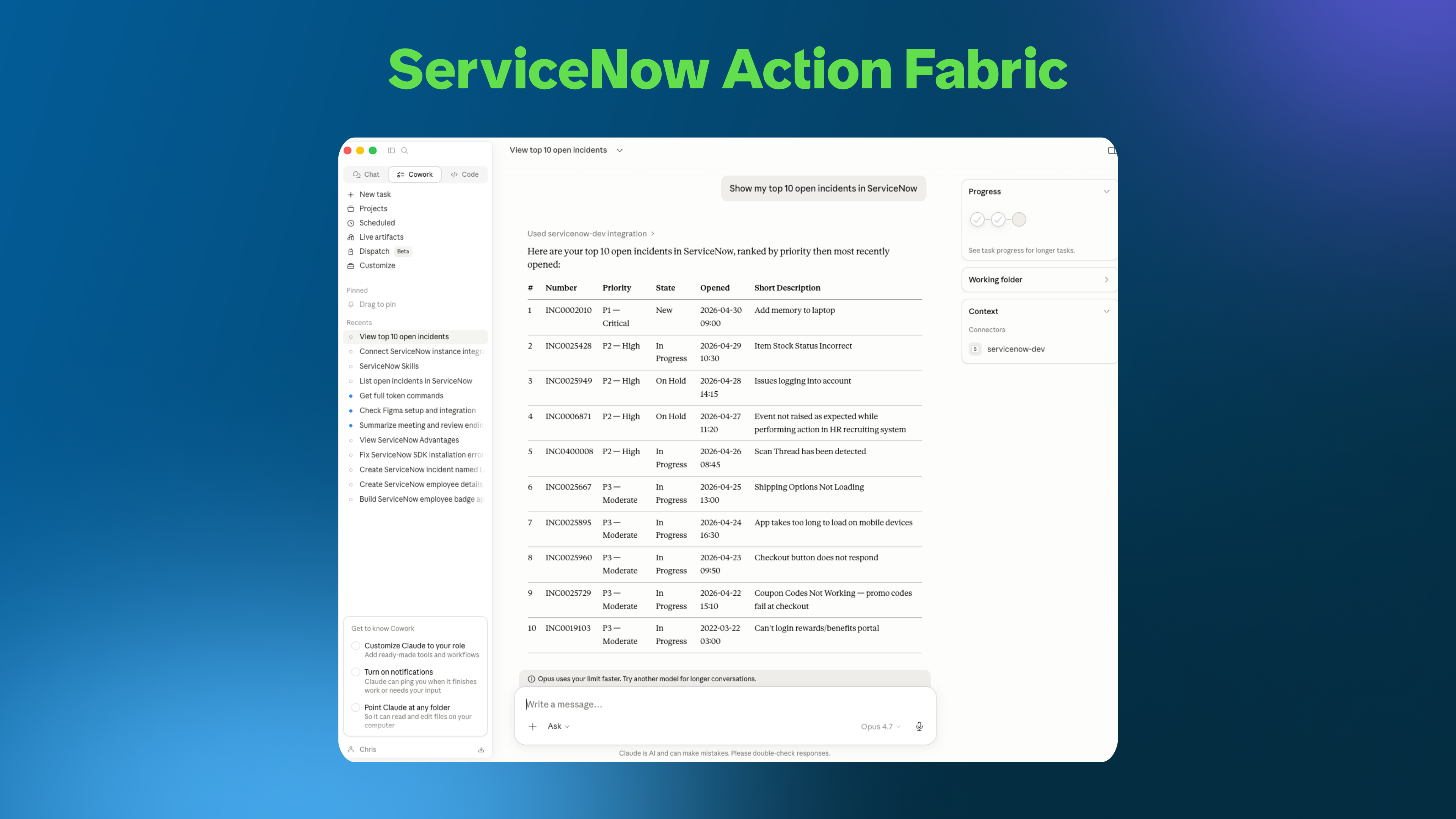
Action Fabric in practice: an AI agent queries ServiceNow, surfaces operational gaps, and routes each item through the correct approval chain. The execution is only as governed as the workflows and data model it acts on.
Experience · Otto
A unified front door surfaces what fragmented ownership created.
Otto is the product ServiceNow built from combining NowAssist with the Moveworks acquisition. It is positioned not as a chatbot but as a single intelligent interface that understands each employee's context — role, team, location, projects, goals, OKRs — and resolves their intent by triggering Action Fabric workflows rather than simply answering questions. An employee in a new role asks what access they are missing. Otto queries the platform, identifies the gaps, and routes each request through the appropriate approval chain. Voice, chat, web, video and enterprise search are all unified surfaces for the same underlying capability.
The ambition is exactly right. The implementation challenge is that Otto's value is a direct function of the domain structure beneath it. If HR, IT, Finance and Procurement are each governed as separate silos with no cross-domain accountability model, Otto becomes a faster way to expose that fragmentation to the employee. A unified front door that reaches into ungoverned back-end processes does not create coherence. It creates a more visible version of the existing incoherence, delivered with greater speed.
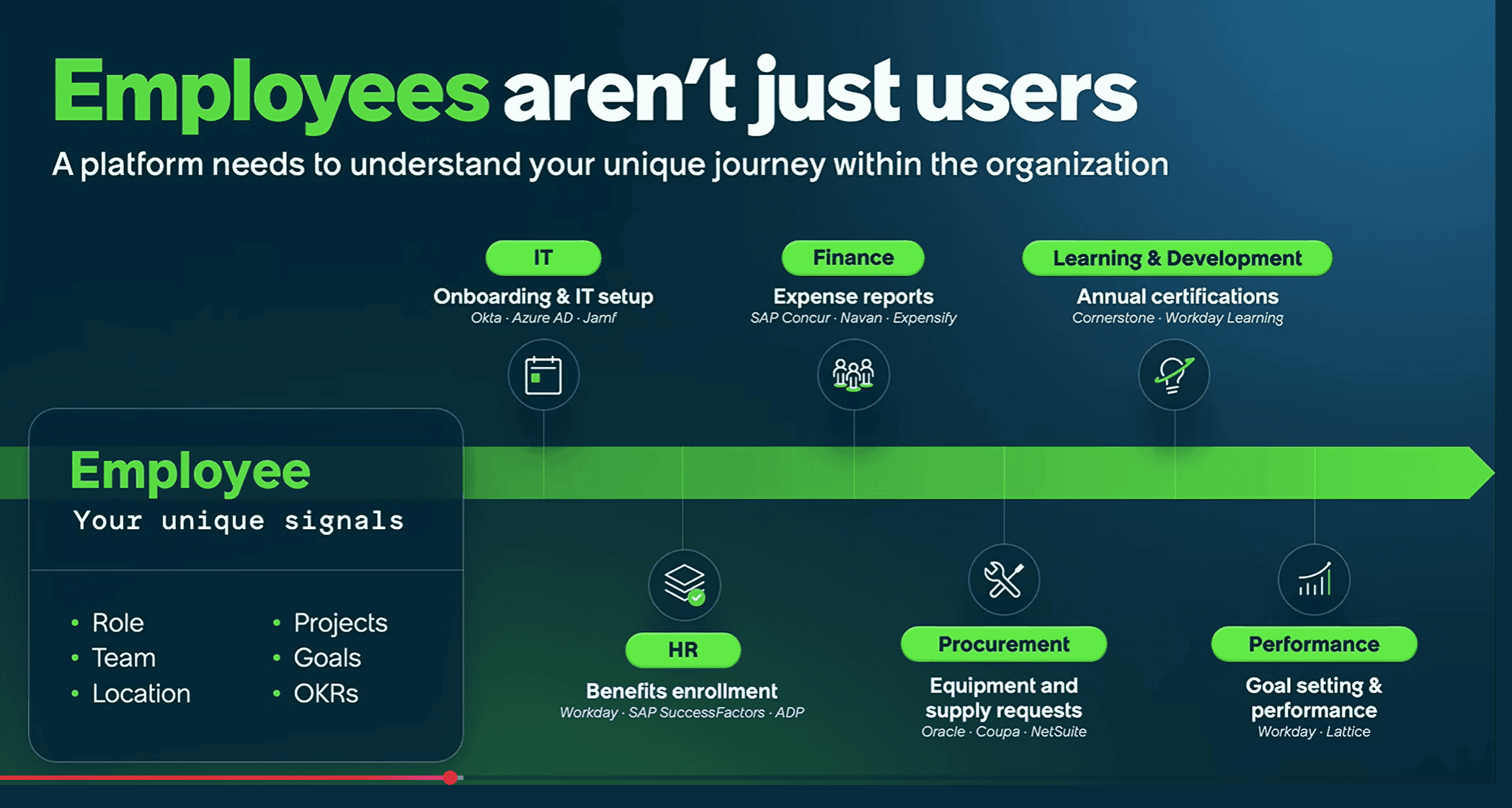
Otto's design premise: the platform understands the full employee journey across every function, personalised by the employee's unique signals. That premise holds when the domain governance model supports it.